Honey Dressings for Burns and Wounds
Ancient Egyptian medicine (recorded on papyrus, 2600–2200 BC); also Greek, Chinese, and Ayurvedic traditions
Evidence: Moderate for partial-thickness burns and infected post-operative wounds — Cochrane review
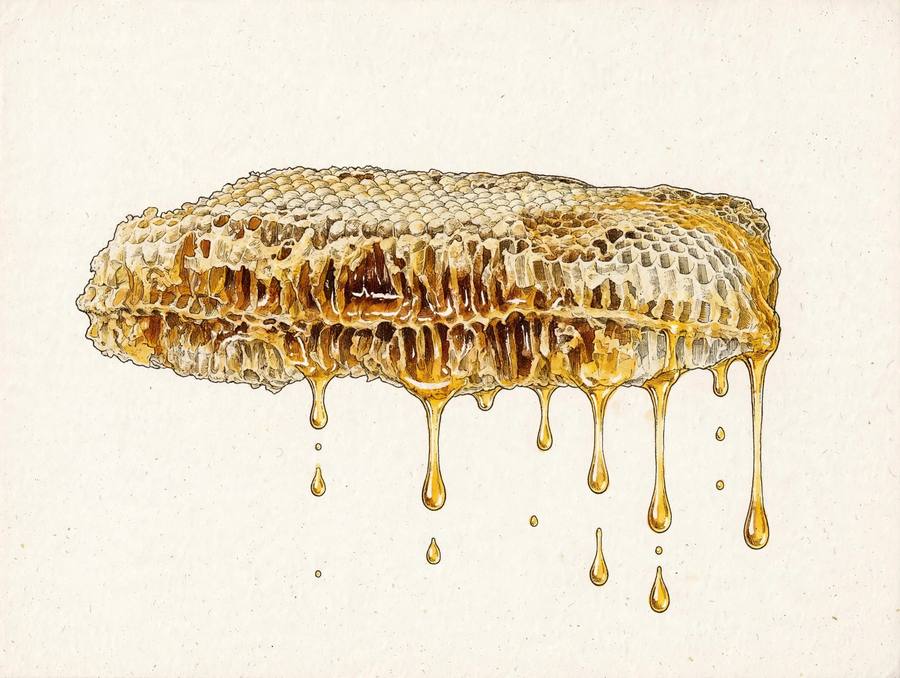
Illustration: Fresh honeycomb
What it is and what it is used for
Raw honey spread directly on a burn or wound and covered with gauze. Honey's antibacterial and wound-healing use is one of the oldest recorded medical practices in the world. A Cochrane review found honey heals partial-thickness burns faster than conventional dressings, and infected post-operative wounds faster than antiseptic washes followed by gauze.
Safety and disclaimers
- For minor burns and superficial wounds only — never for deep or full-thickness burns (the Cochrane review found possible harm versus early excision and grafting).
- Never feed honey to infants under 12 months (infant botulism).
- Allergic reactions are rare but possible.
- No clear benefit was found for venous leg ulcers, diabetic foot ulcers, or minor acute wounds.
- Seek care for burns larger than the palm, burns on face/hands/joints, or any wound showing spreading redness.
Recipe
Ingredients:
- Raw, unprocessed honey
- Sterile gauze pads and bandage
Preparation:
- Cool a minor burn under running water for at least 10 minutes first.
- Spread a thick layer of raw honey over the burn or wound.
- Cover with sterile gauze and bandage loosely.
- Change the dressing daily, reapplying fresh honey.
Dosage / directions: Reapply with each dressing change until healed. Medical-grade (e.g., Manuka) honey dressings are the standardized form used in modern wound care.
Folk history
An Egyptian surgical papyrus from roughly 2600–2200 BC — among the oldest medical texts in existence — instructs the physician to dress wounds with honey. Greek physicians, Chinese herbalists, and Ayurvedic practitioners each arrived at the same practice independently. Honey never truly left medicine: it survives today in sterile, medical-grade wound dressings used in hospitals.
Scientific references
- Cochrane review — Jull et al. 2015: honey for acute and chronic wounds (CD005083) — https://www.cochrane.org/evidence/CD005083_honey-topical-treatment-acute-and-chronic-wounds