Mullein for Coughs and Earaches
European and Native American — tall woolly stalk used as a torch and a lung herb
Evidence: Traditional use — limited or no human trials
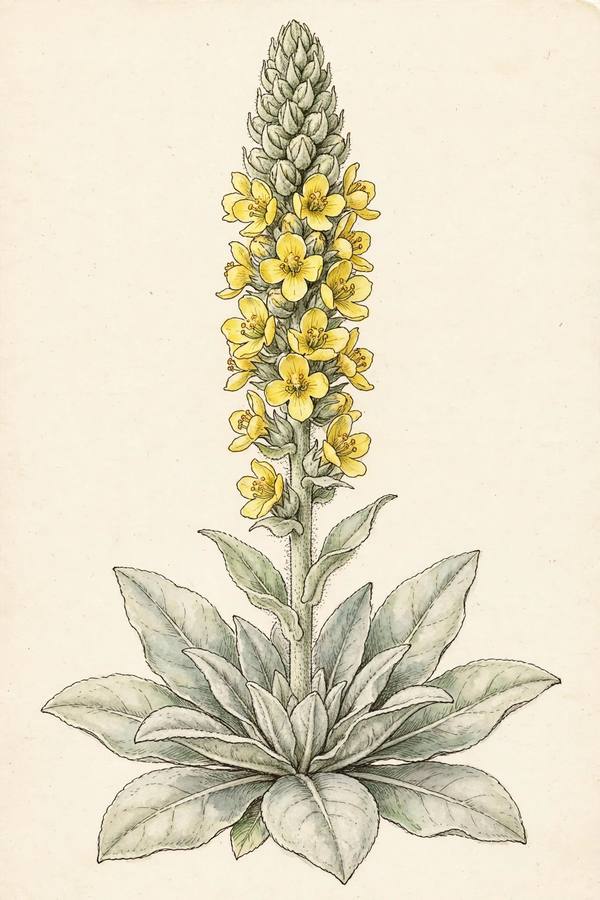
Illustration: Mullein (Verbascum thapsus) — woolly rosette and yellow flower spike
What it is and what it is used for
Mullein (Verbascum thapsus), the tall woolly weed of roadsides, brewed as tea for coughs or used as a flower-infused oil for earaches. Human evidence is thin: one small trial for episiotomy pain (not respiratory), a few observational reports, and conflicting lab work on viruses. It remains a traditional-use remedy with plausible demulcent properties, not a proven treatment.
Safety and disclaimers
- Strain the tea very well — the leaf hairs irritate throats.
- Do not use ear oil if the eardrum may be perforated (drainage, recent injury) — see a clinician.
- Limited pregnancy/lactation safety data.
Foraging and preparing your ingredients
Warning: illustrations and photographs alone are never enough for safe wild identification. Confirm every plant in person with a knowledgeable local expert and at least two reliable field guides before harvesting or eating anything from the wild.
Where and when to find it: Dry roadsides, waste ground, and rocky banks. First-year rosette; second-year tall flower spike (summer).
Identification: Rosette of large, densely WOOLLY, greyish-green leaves with smooth margins; second-year spike of small yellow five-petaled flowers. Compare with the captioned plate.
What to harvest: Leaves in the first year; flowers in the second.
Dangerous look-alikes: CRITICAL: foxglove rosettes are dark green, wrinkled, and NOT woolly — foxglove is deadly. See the High-Risk Index. Confirm the woolly texture before harvesting.
Harvest sustainably: Abundant biennial; take leaves from many rosettes.
Preparing and storing:
- Dry leaves and flowers separately on screens in a dark, airy place.
- Store sealed and dark up to 1 year.
- Strain tea through fine cloth — the leaf hairs irritate throats.
Recipe
Ingredients:
- Dried mullein leaves/flowers, 1–2 teaspoons
- 250 ml just-boiled water
Preparation:
- Steep 10–15 minutes.
- Strain through a fine cloth or coffee filter — the hairs must not reach the cup.
- Drink warm, up to 3 times daily.
Dosage / directions: One cup up to 3 times daily.
Folk history
Roman legionaries dipped mullein stalks in tallow for torches; colonial Americans called it 'velvet plant.' The same woolly leaves that lit roadsides were smoked or brewed for the lungs.
Scientific references
- 2022 narrative review — mullein respiratory evidence (PubMed) — https://pubmed.ncbi.nlm.nih.gov/36771132/