Wild Cherry Bark for Coughs
Native American and Appalachian — inner bark syrups for coughs and colds
Evidence: Traditional use — limited or no human trials
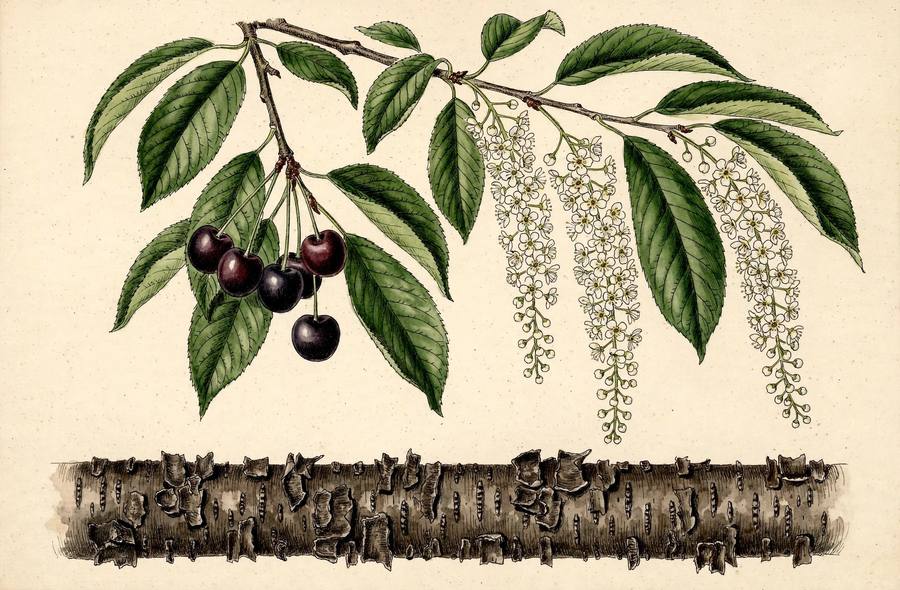
Illustration: Wild cherry (Prunus serotina) bark and flower racemes
What it is and what it is used for
Wild cherry bark (Prunus serotina), the classic ingredient of old-fashioned cough syrups. It contains prunasin, a cyanogenic glycoside — related to the amygdalin in bitter almonds — which may suppress the cough reflex in tiny amounts, but no human trials support the traditional use. The evidence is historical and chemical, not clinical.
Safety and disclaimers
- Cyanogenic compounds: use small amounts, short term only; never use wilted cherry leaves (livestock-killer for the same reason).
- Avoid in pregnancy and children without professional guidance.
- Toxicity signs (nausea, dizziness) mean stop immediately.
Foraging and preparing your ingredients
Warning: illustrations and photographs alone are never enough for safe wild identification. Confirm every plant in person with a knowledgeable local expert and at least two reliable field guides before harvesting or eating anything from the wild.
Where and when to find it: Woodland edges and fencerows of eastern North America. Dark scaly 'burnt potato chip' bark on mature trunks.
Identification: Mature bark dark and scaly; young bark with horizontal lenticels; elongated racemes of white flowers in spring, dark cherries in summer. Inner bark smells of bitter almond.
What to harvest: Small branches pruned in autumn — never strip bark from living trunks (girdling kills).
Dangerous look-alikes: Other Prunus species are similar and not dangerous for bark use; the key caution is cyanogenic content — use small amounts, short term.
Harvest sustainably: Prune branches, never ring-bark. Fallen branches after storms are ideal.
Preparing and storing:
- Dry bark strips in a dark, airy place.
- Cold-infuse as the recipe describes — cold extraction pulls less of the harsh compounds.
- Store dried bark sealed and dark up to 2 years.
Recipe
Ingredients:
- Dried wild cherry bark (Prunus serotina), 1 teaspoon
- 250 ml cold water
- Honey
Preparation:
- Cold-infuse the bark 6–8 hours (cold extraction pulls less of the harsh compounds).
- Strain, warm gently, sweeten with honey.
Dosage / directions: Small sips as needed; short-term use only.
Folk history
Appalachian families kept a jug of wild cherry bark syrup on the shelf next to the honey. It flavored commercial cough medicines well into the 20th century — you can still taste its descendant in cherry-flavored syrups.
Scientific references
- Botanical Safety Handbook notes on Prunus serotina (index-sourced; verify before print) — https://www.abc.herbalgram.org/site/PageServer