Food Preservation
A full harvest you cannot keep is a wasted harvest. This chapter covers the four traditional preservation methods — drying, smoking, fermentation, and pemmican — with the food-safety rules that make them safe. Tradition tells you what people did; the safety rules tell you what actually worked.
Drying and jerky — moisture is the enemy
Preservation by drying has one principle: remove moisture to the point where microbes and enzymes cannot act. Jerky is thin strips of lean meat dried to about a quarter of their original weight.
WARNING — USDA Food Safety and Inspection Service guidance: traditional low-heat drying has caused Salmonella and E. coli O157:H7 outbreaks in homemade jerky. The current USDA recommendation: heat meat to 160°F INTERNAL before drying (165°F for poultry, 145°F for fish) — pre-cook by steaming, roasting, or heating in a hot marinade. Marinade alone does NOT make raw meat safe, and E. coli O157:H7 has a very low infectious dose and survives weeks on dry surfaces.
Method: slice about a quarter inch thick; pre-heat per the rule above; dry at a steady 130–140°F — fast enough to dry the meat before it spoils. Do NOT rush it by raising the temperature: that causes 'case hardening,' a dry crust that traps moisture inside and spoils from within. Done jerky CRACKS when bent double; it should not bend. And sun/air drying is NOT recommended: no steady controlled heat, plus contamination from animals, insects, dust, and bacteria.
- Slice partially-frozen meat — it cuts cleaner and more evenly.
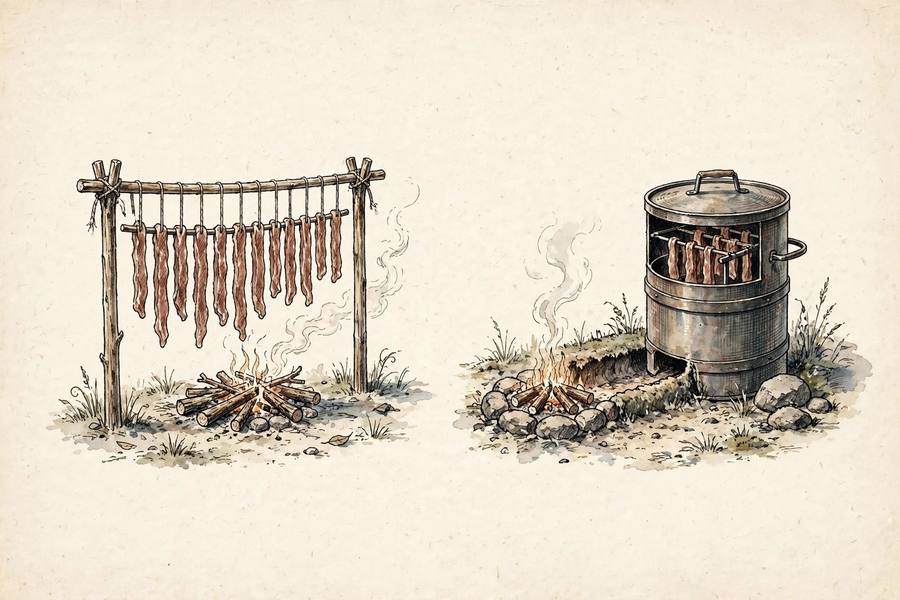
Illustration: Lean strips drying over low heat, beside a field smoker fed by a fire pit through a trench pipe.
Smoking meat and fish — heat preserves, smoke flavors
The core rule: SMOKE ALONE DOES NOT PRESERVE — temperature and drying do. Smoke compounds (phenols, formaldehyde, acetic acid) inhibit bacteria and add flavor, but HEAT is the kill step.
HOT SMOKING (225–275°F): cooks and flavors simultaneously. Finish by INTERNAL temperature — never by time or color: poultry 165°F; whole cuts of beef and pork 145°F; ground meat 160°F; FISH: 145°F internal AND hold for 30 minutes, with 3–3.5% water-phase salt from brining — C. botulinum type E can grow in smoked fish even under refrigeration, and 145°F alone without the hold and the salt is not considered sufficient.
COLD SMOKING (below 90°F, typically 68–86°F): does NOT cook. Only cold-smoke food that is ALREADY fully salt-cured or that will be cooked afterward. WARNING: never eat cold-smoked raw meat or fish without curing or cooking — it is a known botulism route, especially fish in low-oxygen packaging.
WOOD: hardwoods only — hickory, oak, apple, cherry, maple, mesquite. NEVER softwoods like pine or spruce (resinous, bitter, potentially toxic) and never pressure-treated wood. SMOKE QUALITY: you want thin, wispy smoke — thick white smoke lays down creosote (bitter, potentially carcinogenic).
A field smoker: fire pit, then a trench or pipe 4–8 feet long, then a chamber (barrel, box, tarp teepee, or a ground hole with a grate); hang or lay the food on racks in the chamber.
- If the smoke stings your eyes from feet away, it is too thick — damp the fire down.
Fermentation — salt, acidity, and patience
Lacto-fermentation preserves by letting lactic-acid bacteria acidify the food past the point where spoilage organisms survive. The rules are simple and non-negotiable.
SALT: 2–3% salt by WEIGHT of the vegetables (20–30 grams per kilogram). Below about 1.5% risks spoilage; above about 5% inhibits the very bacteria you want. Use non-iodized salt.
ACIDITY — the botulism control: C. botulinum cannot grow below pH 4.6. Keep the food SUBMERGED below the brine (exposed food molds); ferment cool (about 60–70°F); discard anything with foul or off odors or slime; and never 'taste-test' a suspect ferment to check it — that is how people get hurt. Cheap pH strips are good insurance: target pH 4.6 or lower.
NOTE — editorial flag: the salt-ratio and pH rules above are standard food-science consensus, but this chapter's fermentation specifics should be verified against the National Center for Home Food Preservation (NCHFP) before any print edition.
- Weigh your salt — 'a handful' is how ferments fail.
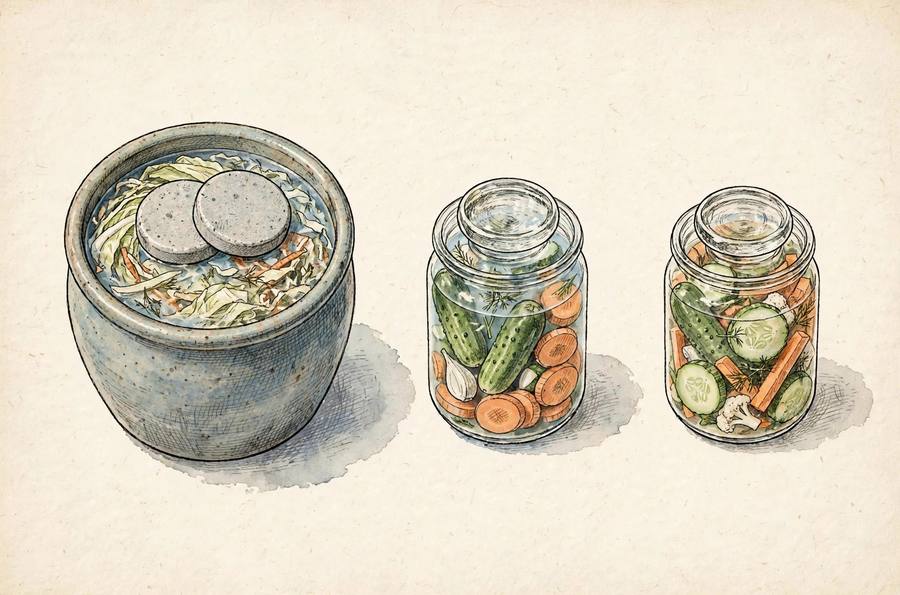
Illustration: Crock and jars packed with vegetables, held beneath the brine by fermentation weights.
Pemmican — the original survival food
Pemmican is dried, powdered lean meat mixed with rendered tallow — traditionally about 50/50 by weight, sometimes with dried berry powder. Originated with the Cree, staple of the fur trade: calorie-dense and shelf-stable for years when it is truly dry and airtight.
Steps: 1) Trim ALL fat from the meat — fat left on goes rancid; dry only lean. 2) Salt lightly if at all (about a teaspoon per pound; traditional versions are often unsalted — and NEVER sugary or soy marinades for long-storage pemmican). 3) Dry the strips until they CRACK when bent double — no rubberiness; any remaining moisture means mold and bacteria. 4) Grind to a fibrous powder. 5) Render suet to tallow and strain out the cracklings. 6) Mix roughly equal weights of powder and tallow (some recipes add about 1.5% salt). 7) Form bars or balls; wrap; store cool, dark, and dry. Yield: about 5 pounds of raw meat to 1 pound of dried. Adding berries shortens shelf life (moisture plus sugars) — the tradeoff for flavor.
- If it bends, it is not done. If it crumbles to powder, it is.
Caching and storage
Preserved food still needs proper storage: cool, dark, and dry; airtight (vacuum bags, sealed jars); off the ground; protected from rodents and insects (hang caches, use metal containers); rotated stock; everything labeled with dates. And cache food AWAY from your sleeping area — a food cache in camp is an invitation to the animals you read about in the next chapter.
- Check caches after storms — water finds every weakness.