Water — Finding and Purifying
You can live weeks without food and only days without water — and bad water can take you down faster than thirst. This chapter covers finding water when none is obvious, then purification in depth: what each method kills, and just as important, what it does NOT handle.
Finding water — read the land
Walk DOWNHILL: water collects in valleys, depressions, and low areas. On rocky hillsides look for dark patches on rock faces and check crevices — north-facing ones hold rainwater longest. In a dry creek bed, dig a few inches into damp soil; water often sits just below the surface.
Vegetation is a signpost: a patch of lush green growth standing out in a dry landscape — willows, cottonwoods, ferns, cattails — means moisture. Follow animal trails; wildlife heads to water on schedule. Watch for bees, mosquitoes, and flies congregating. Two plant sources worth knowing: cracked bamboo sections hold water (cut segments make cups — purify the water first, insects get in), and a banana or plantain trunk cut about a foot up and hollowed out will pool root water within minutes.
- Morning dew can be collected by dragging a cloth through grass and wringing it into a container.
Solar stills and transpiration bags — know their limits
The below-ground solar still: dig a bowl about 3 feet across and 2 feet deep in direct sun (damp soil works best; scatter vegetation around — not in — a center container), cover it with clear plastic sealed at the edges with rocks and soil, and set a small rock in the plastic's center over the container so condensation drips in.
The transpiration bag: tie a clear plastic bag AIRTIGHT over a leafy branch in direct sun, with a small stone in a low corner to make a collection point, and wait hours for condensation to pool.
MYTH CORRECTION: survival media presents these as major water sources. Military field sources rate a still at roughly half a liter to a liter per DAY — a supplement, never a primary source, and energy-expensive to dig. WARNING: never use a poisonous plant in a transpiration bag — toxins can end up in the condensed water. And purify the collected water afterward; condensation is not sterilization.
- Build a still only when you have water to spare for the effort — it is a bad trade when you are already dehydrated.
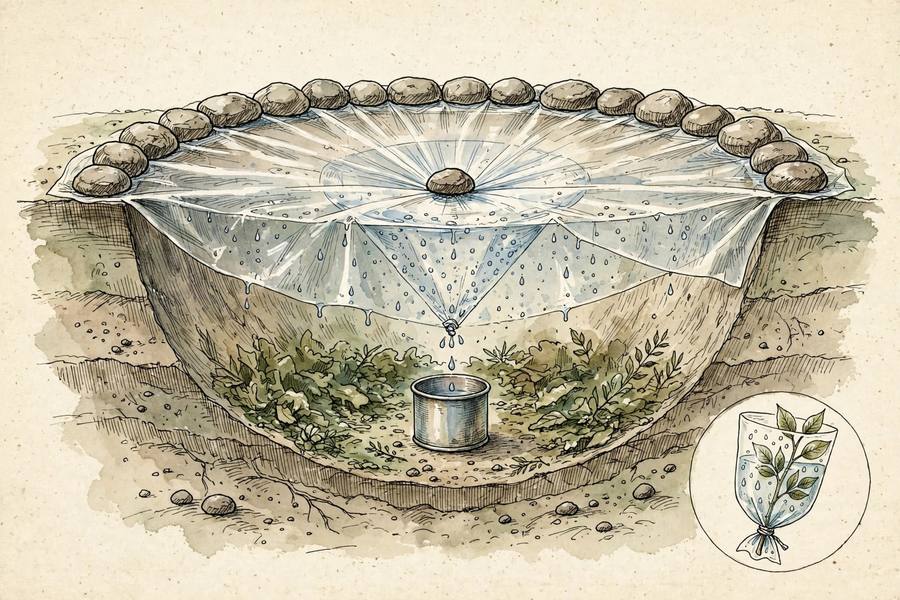
Illustration: Below-ground solar still (with transpiration-bag inset): plastic sheet, center stone, and collection cup.
Boiling — the surest method (CDC)
The CDC calls boiling the surest way to kill disease-causing organisms, including viruses, bacteria, and parasites such as Cryptosporidium and Giardia. The rule: a rolling boil for 1 MINUTE; at elevations above 6,500 FEET, 3 MINUTES.
What boiling does NOT remove: chemicals, salts, heavy metals, radioactive materials, and algal toxins. If the water is cloudy, pre-filter it through cloth, a paper towel, or a coffee filter first, or let the sediment settle and pour off the clear top — and never add untreated water to the pot after boiling.
NOTE — conflicting advice, flagged honestly: the CDC's 3-minute rule is conservative. The WHO and some backpacking authorities note that simply reaching a rolling boil kills pathogens at any elevation, since pathogens die well below boiling temperature. Both are presented here; the CDC guidance is the regulatory citation this book follows.
- A rolling boil looks like a violent, churning surface — a few lazy bubbles is not a boil.
Filtration — pore size is everything (CDC)
Not all filters are equal, and the label is full of traps. What matters is absolute pore size:
1 micron absolute or smaller (or NSF 53/58 certified for cyst reduction): removes parasites — Cryptosporidium and Giardia. Does NOT reliably remove viruses or all bacteria.
0.3 micron absolute or smaller: removes bacteria AND parasites. Does NOT remove viruses.
~0.01 micron (ultrafiltration): removes protozoa and bacteria at very high rates and viruses at moderate rates; poor against chemicals.
Reverse osmosis: removes parasites, bacteria, and viruses — and also salt.
The CDC's plain-English summary: most portable water filters remove parasites but not viruses or bacteria. LABEL TRAP: 'nominal' pore size, '1-micron filter,' 'carbon filter,' 'effective against Giardia,' and 'EPA approved' do NOT guarantee cyst removal (the EPA does not approve or test filters for Cryptosporidium). Look for the word ABSOLUTE or an NSF 53/58 certification for cyst reduction.
- In North American backcountry, the main threats are Giardia and Cryptosporidium — a 0.2–0.3 micron absolute filter covers both.
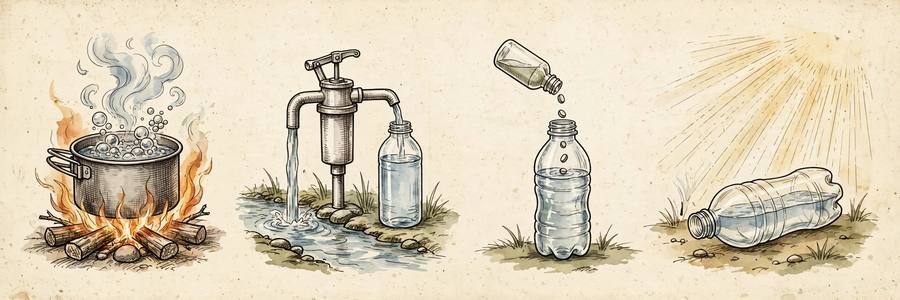
Illustration: Four ways to make water safe: boil, pump filter, purifying tablets, and SODIS sun disinfection.
Chemical treatment — know what it misses
Bleach and iodine kill viruses and bacteria but are POOR against parasites — including Cryptosporidium. Chlorine dioxide tablets are the stronger option: they kill bacteria and viruses, kill Giardia, and are somewhat effective against Cryptosporidium — but the CDC still says it is safest to FILTER first to remove parasites, then disinfect.
And the hard limit on ALL of these methods: none of boiling, bleach, iodine, chlorine tablets, pitcher filters, or ordinary backpacking filters makes water safe if it contains harmful chemicals, fuels, pesticides, toxins, or radioactive material. If the water smells of chemicals or fuel, find another source.
- Follow the product's contact time exactly — cold or cloudy water needs longer.
SODIS and UV
SODIS (solar disinfection): fill a clear PET bottle and expose it to full sun for about 6 hours (2 days if cloudy). UV-A plus heat kills pathogens — but the water must be clear to start with. UV devices (pen lights) are effective against all pathogen classes but need batteries and clear water. Neither method removes chemicals, salt, or particulates; UV is disinfection, not purification, unless combined with filtration.
- SODIS is a good method for clear tropical water; it is a poor method for silty mountain runoff.