Lion's Mane Mushroom for Memory and Mood
Chinese and Japanese culinary-medicinal tradition — a gourmet mushroom studied for the aging brain
Evidence: Moderate but early — small RCTs show improved cognitive scores in mild cognitive impairment; a 2024 systematic review (34 human studies) found it the most consistent mushroom for cognitive/mood benefit
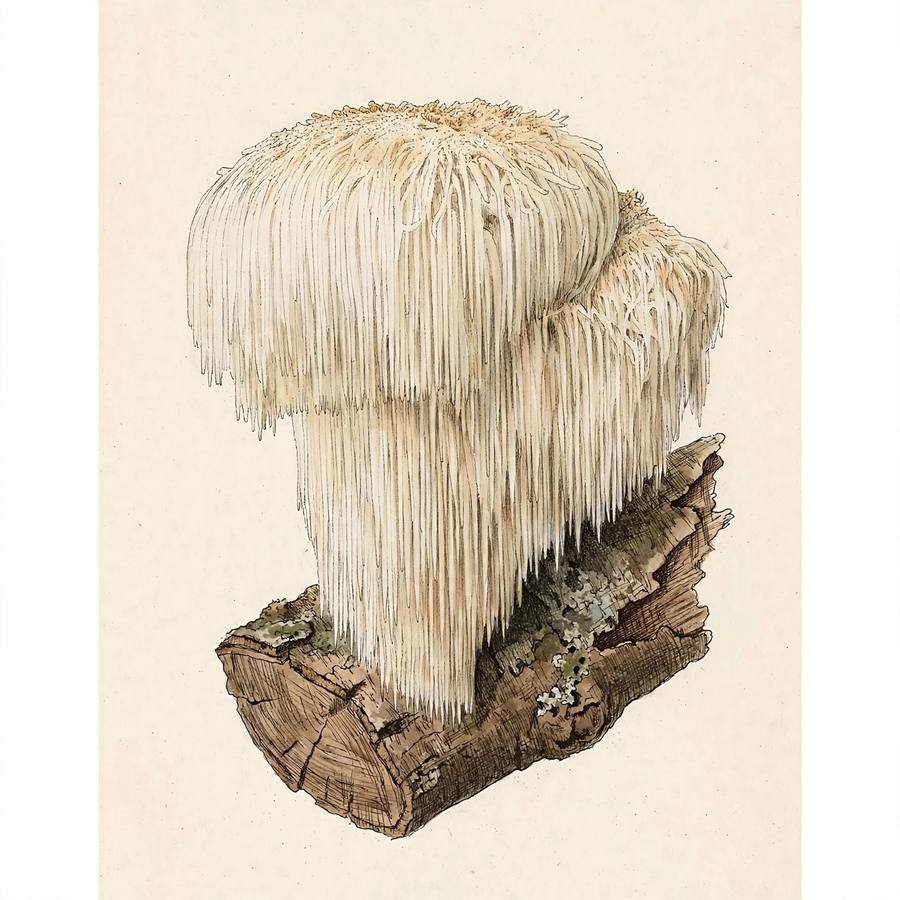
Illustration: Lion's mane mushroom (Hericium erinaceus)
What it is and what it is used for
Lion's mane mushroom (Hericium erinaceus), the white cascading 'icicle' fungus, eaten or taken as extract for memory, focus, and mood. A 2009 Japanese trial (30 adults aged 50–80 with mild cognitive impairment, 3 g/day for 16 weeks) improved cognitive scores at weeks 8, 12, and 16 — though gains faded after stopping. A 2024 systematic review of 34 human studies found lion's mane the most consistently beneficial mushroom for cognition and mood in middle-aged and older adults. Samples remain small; larger trials are needed.
Safety and disclaimers
- Well tolerated in trials (one dropout for stomach discomfort).
- Never eat a wild mushroom you cannot positively identify — this rule has no exceptions. Lion's mane itself has no dangerous look-alikes, but the rule stands.
- Not a treatment for dementia — discuss cognitive concerns with a clinician.
Foraging and preparing your ingredients
Warning: illustrations and photographs alone are never enough for safe wild identification. Confirm every plant in person with a knowledgeable local expert and at least two reliable field guides before harvesting or eating anything from the wild.
Where and when to find it: Wounds of dead and dying hardwoods (oak, beech, maple) in autumn. Cascading white icicle-like spines — unmistakable.
Identification: White to cream pompom of hanging icicle spines on hardwood. No dangerous look-alike — but the universal mushroom rule stands: never eat a wild mushroom you cannot positively identify.
What to harvest: Cut young, white, firm specimens; leave older yellowing ones to spore.
Dangerous look-alikes: Coral fungi and bear's-head tooth (also Hericium — also edible) are similar; none are dangerous. When in doubt, consult a mycological society.
Harvest sustainably: Cut, don't pull; leave part of the fruiting body to release spores.
Preparing and storing:
- Cook fresh promptly — sauté, roast, or simmer into broth.
- Dry slices at low heat for tea/broth; store sealed and dark up to 1 year.
Recipe
Ingredients:
- Fresh lion's mane mushroom (Hericium erinaceus), cultivated or positively wild-identified
- Butter or oil, salt
Preparation:
- Tear into chunks; sauté in butter over medium-high heat until golden — its texture is famously crab-like.
- For a traditional-style preparation, simmer dried slices 30–60 minutes into broth or tea.
- Note: trials used powdered fruiting body or extracts; culinary use is the enjoyable traditional approximation.
Dosage / directions: As food, freely. Trial dose was 3 g/day of dried powder.
Folk history
Buddhist monks reportedly drank lion's mane tea to sharpen focus for meditation — the 'mountain priest' mushroom. In the wild it fruits on hardwood wounds, looking like a frozen waterfall or a white lion's mane. It went from temple tea to neuroscience journals in about a decade, one of the fastest folk-to-lab journeys in this book.
Scientific references
- Mori et al. 2009 (Phytotherapy Research) — lion's mane RCT in mild cognitive impairment — https://inpharmd.com/inquiries/a768270122980086bcd689a8787689e984007c694ca8937ce5924b87b366e04