Turkey Tail Mushroom as a Cancer-Treatment Companion
Chinese and Japanese medicine (yunzhi) — used alongside conventional cancer therapy, not instead of it
Evidence: Moderate for ADJUNCT use only — pharmaceutical extracts (PSK/PSP) with chemotherapy: meta-analyses show modest survival benefit (gastric HR 0.88, colorectal HR 0.71); PSK approved in Japan since 1977 as a chemo adjunct
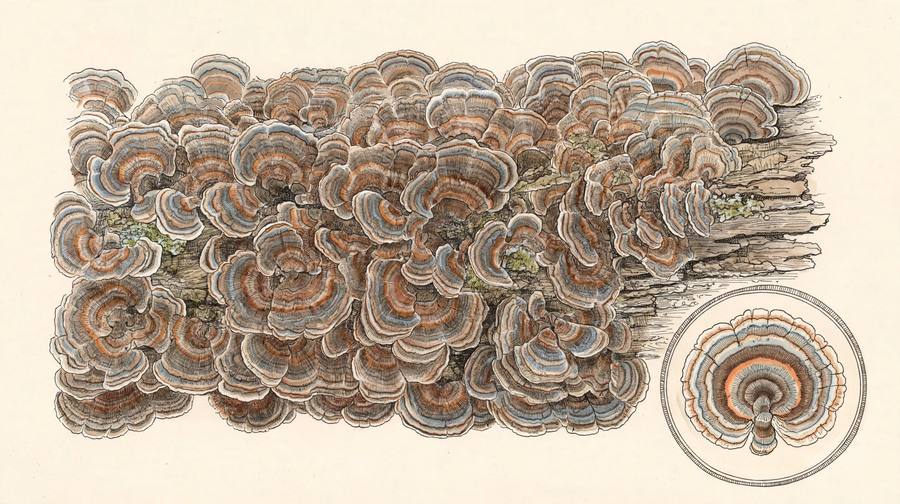
Illustration: Turkey tail fungus (Trametes versicolor) on wood
What it is and what it is used for
Turkey tail (Trametes versicolor) — strictly as a companion to conventional cancer treatment, never a replacement. Its pharmaceutical extracts PSK and PSP (polysaccharide-K/peptide) are approved in Japan since 1977 as chemotherapy adjuncts; meta-analyses found modest survival benefits alongside chemo for gastric and colorectal cancers (about a 9% absolute reduction in 5-year mortality). KEY CAVEAT, stated plainly: trials used extracted PSK/PSP, not mushroom tea — results do not transfer to homemade preparations. It does not treat cancer alone, and a 2023 systematic review called the evidence for routine use inconclusive.
Safety and disclaimers
- This entry is information, not a recommendation to self-treat. Any use alongside cancer therapy must be discussed with the oncology team — interactions with chemo regimens are possible.
- Safe up to 9 g/day in trials (of extracts).
- Never delay or replace conventional cancer treatment with mushrooms.
Foraging and preparing your ingredients
Warning: illustrations and photographs alone are never enough for safe wild identification. Confirm every plant in person with a knowledgeable local expert and at least two reliable field guides before harvesting or eating anything from the wild.
Where and when to find it: Dead hardwood logs and stumps, year-round. Thin fan-shaped brackets with concentric multicolor zones.
Identification: Thin, flexible, fan-shaped brackets with concentric zones of brown, tan, blue-grey, and a white margin; pale pore surface underneath. True turkey tail is thin and flexible.
What to harvest: Collect firm, fresh brackets; avoid old algae-covered ones.
Dangerous look-alikes: False turkey tail (Stereum) is smooth underneath (no pores) — harmless but not the same. Violet-toothed polypore has a purple edge. Check the pore surface with a hand lens.
Harvest sustainably: Abundant on dead wood; take a portion and leave the rest.
Preparing and storing:
- Dry thoroughly at low heat; store sealed and dark up to 2 years.
- Simmer 45–60 minutes for decoction — the brackets are too tough to eat.
- Remember: trials used extracted PSK/PSP, not home tea.
Recipe
Ingredients:
- Dried turkey tail (Trametes versicolor), positively identified, 5–10 g
- 1 liter water
Preparation:
- Simmer 45–60 minutes into a strong decoction; strain.
- Understand clearly: this tea is NOT the PSK/PSP extract used in trials. It is included as the traditional preparation, with the evidence caveat above.
Dosage / directions: One to two cups daily as a traditional tea. Discuss any use during cancer treatment with your oncologist first.
Folk history
In Japan, turkey tail extract became a mainstream pharmaceutical — prescribed by oncologists, covered by insurance — while in the West it remained a health-food curiosity. The mycologist Paul Stamets helped bring it into American clinical research after his mother's experience with breast cancer. It is the book's clearest example of the gap between a folk preparation and the pharmaceutical it became.
Scientific references
- NIH-funded 2012 trial — turkey tail immune effects after chemotherapy (see research notes; index-sourced, verify before print) — https://www.cancer.gov/about-cancer/treatment/cam/hp/mushrooms-pdq